
 Image 1 of 1
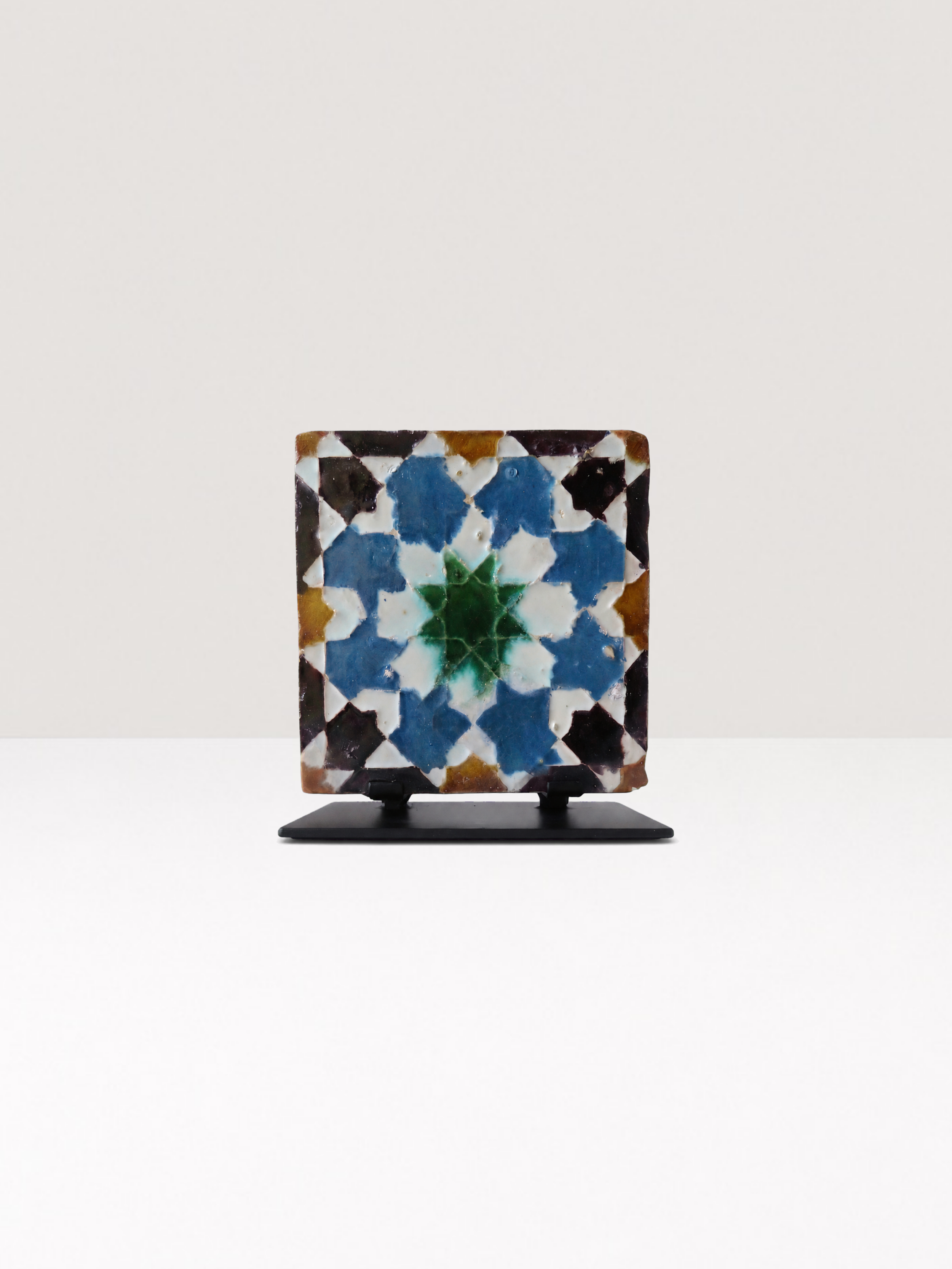
A glazed mudejar arista tile, decorated with zeolite style depicting an eight-pointed star.
Sevilla, Spain. Early 16th century.
Height: 13 cm (5.12 in) Width: 13 cm (5.12 in)
Additional Information
This tile is a prime example of the architectural trompe-l'œil developed in 16th-century Sevilla. Whilst the zellige of Fez or the alicatado of the Alhambra required each tiny geometric shape to be cut by hand and assembled like a mosaic, the Sevillian technique of the arista made it possible to achieve the same visual grandeur using a single moulded tile. Using a sophisticated wooden mould, the craftsman imprinted grooves into the clay that perfectly replicated the sharp, crystalline edges of hand-cut mosaics. To the 16th-century viewer, these tiles offered the high-class aesthetics of a royal palace combined with the technical efficiency of Spain’s burgeoning industry.
The similarity to Moroccan zellige is further reinforced by the choice of colour palette. The master potters of the Triana district used the same mineral oxides found in North African workshops: cobalt blue for the sky, copper green for paradise and honey amber for the earth. As the arista technique creates a physical basin for each colour, the glazes remain pure and saturated, never blending into one another. This produces the high-contrast surface that is the hallmark of traditional mosaic, allowing the intricate eight-pointed star to stand out with the same clarity as if it were composed of dozens of individual fragments.
A glazed mudejar arista tile, decorated with zeolite style depicting an eight-pointed star.
Sevilla, Spain. Early 16th century.
Height: 13 cm (5.12 in) Width: 13 cm (5.12 in)
Additional Information
This tile is a prime example of the architectural trompe-l'œil developed in 16th-century Sevilla. Whilst the zellige of Fez or the alicatado of the Alhambra required each tiny geometric shape to be cut by hand and assembled like a mosaic, the Sevillian technique of the arista made it possible to achieve the same visual grandeur using a single moulded tile. Using a sophisticated wooden mould, the craftsman imprinted grooves into the clay that perfectly replicated the sharp, crystalline edges of hand-cut mosaics. To the 16th-century viewer, these tiles offered the high-class aesthetics of a royal palace combined with the technical efficiency of Spain’s burgeoning industry.
The similarity to Moroccan zellige is further reinforced by the choice of colour palette. The master potters of the Triana district used the same mineral oxides found in North African workshops: cobalt blue for the sky, copper green for paradise and honey amber for the earth. As the arista technique creates a physical basin for each colour, the glazes remain pure and saturated, never blending into one another. This produces the high-contrast surface that is the hallmark of traditional mosaic, allowing the intricate eight-pointed star to stand out with the same clarity as if it were composed of dozens of individual fragments.