
 Image 1 of 1
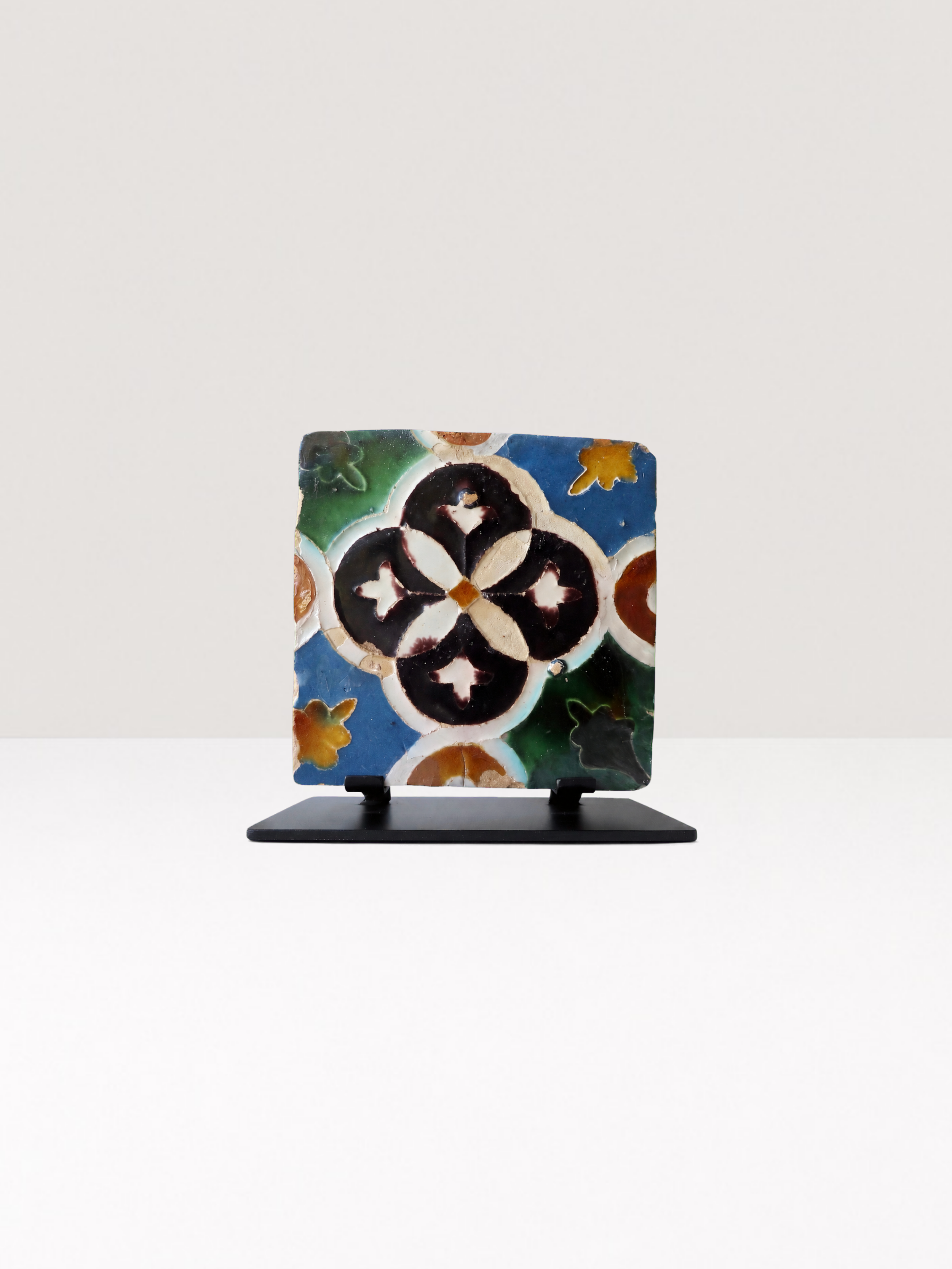
A glazed mudejar arista tile with a quadrifoil floral motif.
Sevilla, Spain. 16th century.
Height: 13 cm (5.12 in) Width: 13 cm (5.12 in)
Additional Information
This tile is an exceptional example of four-axis radial symmetry, a design that allowed Triana potters to create infinite patterns by combining several pieces. Whilst tiles featuring geometric interlacing patterns look back to the Al-Andalus period, this design—with manganese-coloured petals and leaf-shaped finials at the corners—shows the influence of 16th-century European architectural decoration. The precision of the edges on this piece is remarkable, allowing the contrast between the deep black, copper green and cobalt blue to be sharp and vibrant.
This piece acts as a visual bridge between Mudejar technique and the naturalism of the European Renaissance. In the 16th century, Seville became a melting pot where the artisans of Triana, heirs to Al-Andalusian craftsmanship, began to integrate the ornamental repertoire of Plateresque and Italian influences into their moulds. This context of hybridisation defines the essence of late Mudejar ceramics: a material resilience of local traditions that integrates European modernity, allowing an object with Islamic roots to fit perfectly into the aesthetic of the new palaces and convents of Christendom.
A glazed mudejar arista tile with a quadrifoil floral motif.
Sevilla, Spain. 16th century.
Height: 13 cm (5.12 in) Width: 13 cm (5.12 in)
Additional Information
This tile is an exceptional example of four-axis radial symmetry, a design that allowed Triana potters to create infinite patterns by combining several pieces. Whilst tiles featuring geometric interlacing patterns look back to the Al-Andalus period, this design—with manganese-coloured petals and leaf-shaped finials at the corners—shows the influence of 16th-century European architectural decoration. The precision of the edges on this piece is remarkable, allowing the contrast between the deep black, copper green and cobalt blue to be sharp and vibrant.
This piece acts as a visual bridge between Mudejar technique and the naturalism of the European Renaissance. In the 16th century, Seville became a melting pot where the artisans of Triana, heirs to Al-Andalusian craftsmanship, began to integrate the ornamental repertoire of Plateresque and Italian influences into their moulds. This context of hybridisation defines the essence of late Mudejar ceramics: a material resilience of local traditions that integrates European modernity, allowing an object with Islamic roots to fit perfectly into the aesthetic of the new palaces and convents of Christendom.