
 Image 1 of 1
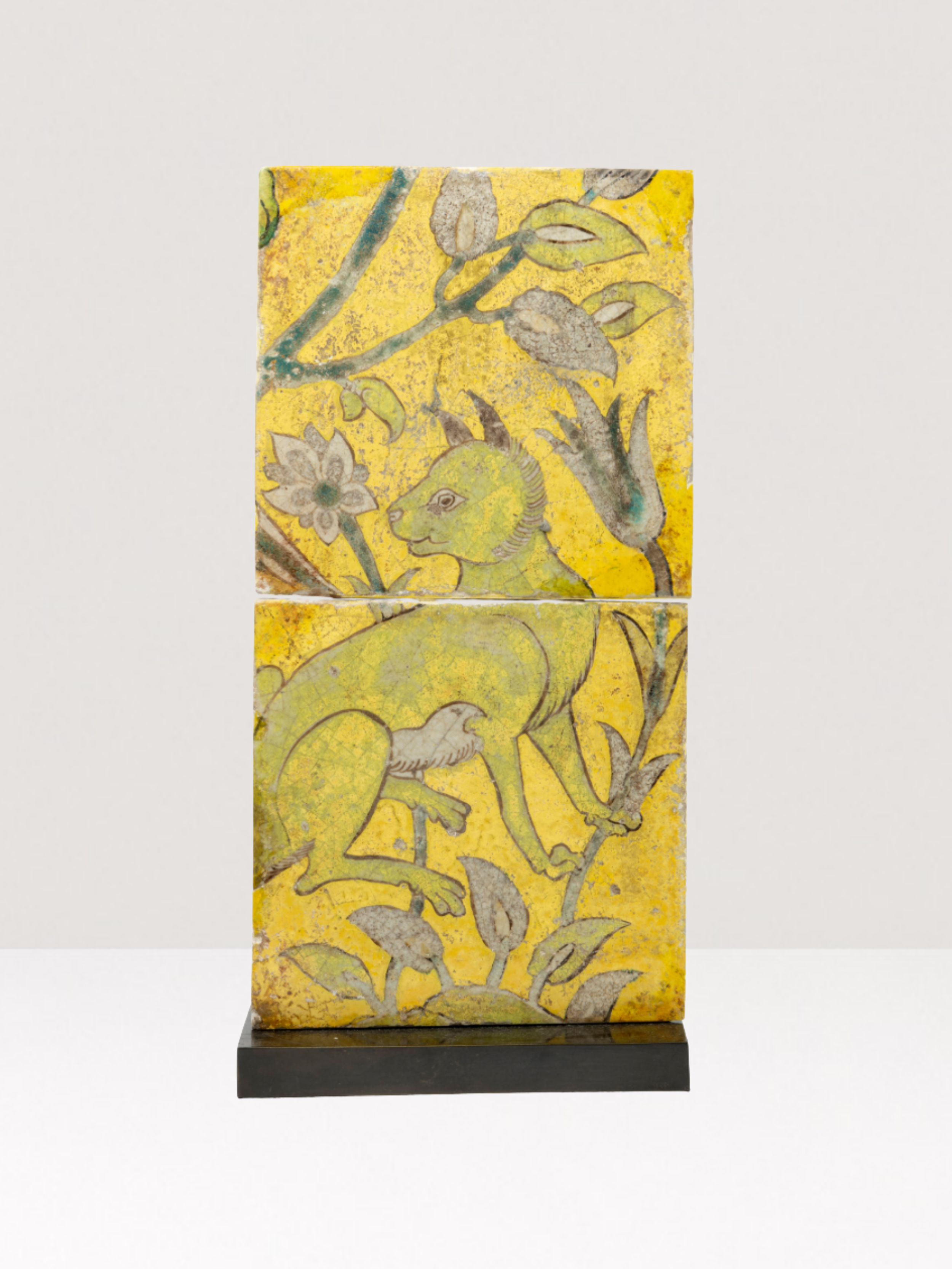
A Safavid pair of tiles depicting a Lynx and floral motifs in polychrome glazed cuerda seca (haft-rangi) technique
Isfahan, Iran, c. 1650–1680
Height: 44.6 cm Width: 22.4 cm
Additional Information
During the Safavid Dynasty, particularly under the reign of Shah Abbas I and his successors in Isfahan, the decorative arts experienced a golden age. Tile panels executed in the cuerda seca technique were widely used to adorn the walls of palaces, garden pavilions (koshk), and noble residences.
In contrast to religious art, Safavid secular architecture favored rich figurative iconography celebrating hunting themes, local and fantastical fauna, and the poetic concept of the garden or paradise. The inclusion of felines and game animals set within floral compositions on a yellow ground is a hallmark of 17th-century Isfahan ceramic workshops, making this pair a compelling example of early modern Persian ceramic art.
The animal is seated on its hind legs, upright, with its head turned toward the left. Its distinctive anatomical features are clearly visible, including pointed ears crowned with tufts, a slender body, and defined claws. The outline of the feline is rendered in black manganese lines and filled with a light green pigment.
Surrounding the creature is an intricate botanical motif characteristic of the Persian Islamic repertoire: sinuous green stems, lanceolate leaves, and palmettes in grey and turquoise tones, alongside stylized lotus or chrysanthemum blossoms.
Provenance
In a French château collection, since at least 1860.
Acquired by a Danish private collector in 1970.
Thence by descent within the family until 2020.
A Safavid pair of tiles depicting a Lynx and floral motifs in polychrome glazed cuerda seca (haft-rangi) technique
Isfahan, Iran, c. 1650–1680
Height: 44.6 cm Width: 22.4 cm
Additional Information
During the Safavid Dynasty, particularly under the reign of Shah Abbas I and his successors in Isfahan, the decorative arts experienced a golden age. Tile panels executed in the cuerda seca technique were widely used to adorn the walls of palaces, garden pavilions (koshk), and noble residences.
In contrast to religious art, Safavid secular architecture favored rich figurative iconography celebrating hunting themes, local and fantastical fauna, and the poetic concept of the garden or paradise. The inclusion of felines and game animals set within floral compositions on a yellow ground is a hallmark of 17th-century Isfahan ceramic workshops, making this pair a compelling example of early modern Persian ceramic art.
The animal is seated on its hind legs, upright, with its head turned toward the left. Its distinctive anatomical features are clearly visible, including pointed ears crowned with tufts, a slender body, and defined claws. The outline of the feline is rendered in black manganese lines and filled with a light green pigment.
Surrounding the creature is an intricate botanical motif characteristic of the Persian Islamic repertoire: sinuous green stems, lanceolate leaves, and palmettes in grey and turquoise tones, alongside stylized lotus or chrysanthemum blossoms.
Provenance
In a French château collection, since at least 1860.
Acquired by a Danish private collector in 1970.
Thence by descent within the family until 2020.