
 Image 1 of 1
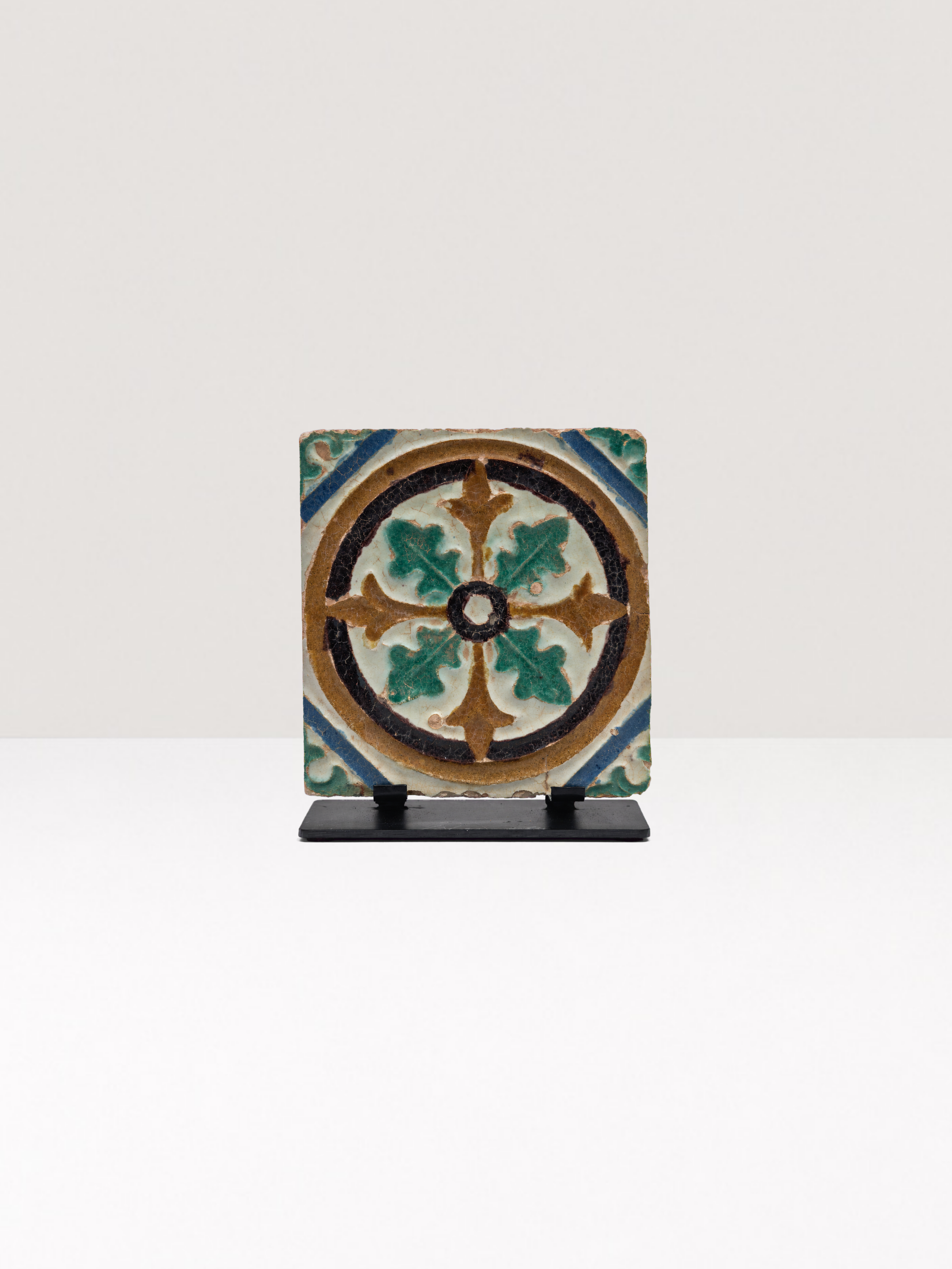
A glazed mudejar arista tile, decorated with a floral medallion.
Sevilla, Spain. First half of the 16th Century.
Height: 14 cm (5.51 in) Width: 13 cm (5.12 in)
Additional Information
The central composition features a circular medallion enclosing a four-fold symmetrical floral motif, consisting of alternating stylised oak leaves in emerald green and amber-toned fleur-de-lis.
This tile marks a fascinating stylistic transition in the workshops of Triana, Seville. While the arista technique remains a legacy of the Mudejar artisans, the ornamentation moves away from strict geometric interlace toward the Renaissance floral repertoire. The use of the central medallion and the four-fold symmetry reflects the influence of Italian decorative prints that were circulating in Spain during the reign of Charles V.
A series of these tiles would create a continuous pattern of interlocking circles and floral stars, transforming a cold wall into a vibrant, permanent garden. Today, individual tiles from the first half of the 16th century are highly valued by collectors as fragments of the artistic bridge between Europe and the Islamic world.
A glazed mudejar arista tile, decorated with a floral medallion.
Sevilla, Spain. First half of the 16th Century.
Height: 14 cm (5.51 in) Width: 13 cm (5.12 in)
Additional Information
The central composition features a circular medallion enclosing a four-fold symmetrical floral motif, consisting of alternating stylised oak leaves in emerald green and amber-toned fleur-de-lis.
This tile marks a fascinating stylistic transition in the workshops of Triana, Seville. While the arista technique remains a legacy of the Mudejar artisans, the ornamentation moves away from strict geometric interlace toward the Renaissance floral repertoire. The use of the central medallion and the four-fold symmetry reflects the influence of Italian decorative prints that were circulating in Spain during the reign of Charles V.
A series of these tiles would create a continuous pattern of interlocking circles and floral stars, transforming a cold wall into a vibrant, permanent garden. Today, individual tiles from the first half of the 16th century are highly valued by collectors as fragments of the artistic bridge between Europe and the Islamic world.