
 Image 1 of 1
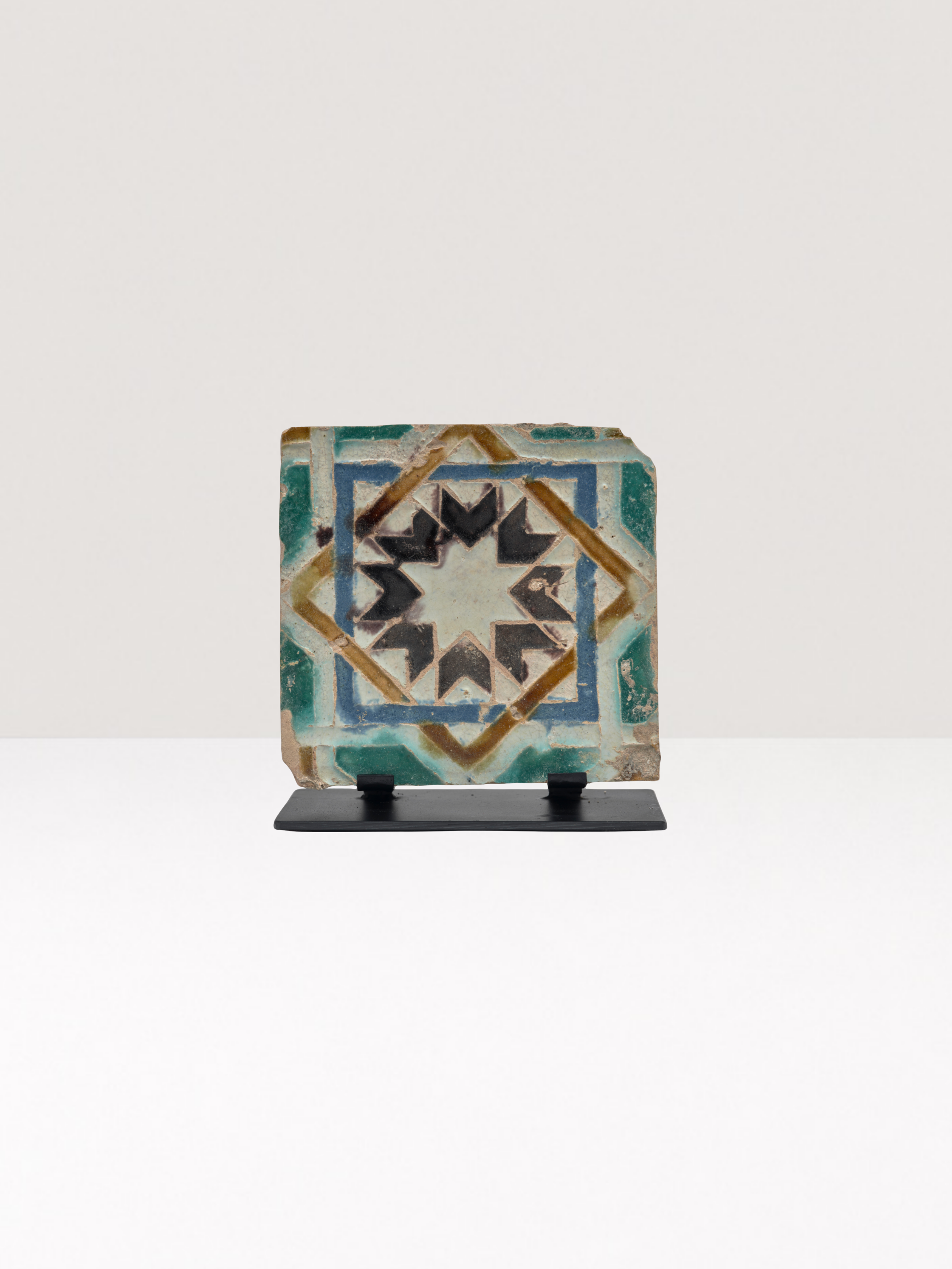
A glazed mudejar arista tile, decorated with interlacing patterns depicting an eight-pointed star.
Sevilla, Spain. Early 16th century.
Height: 13 cm (5.12 in) Width: 13 cm (5.12 in)
Additional Information
By the early 16th century, Seville had perfected the arista technique as a more efficient evolution of the labor-intensive cuerda seca. By using a wooden mold to press the design into the damp clay, potters created raised ridges (aristas) that acted as physical barriers, preventing the different colored glazes from mixing during firing. This allowed for the creation of intricate, repetitive geometric patterns that could cover vast architectural surfaces giving Sevillian ceramics their world-renowned reputation.
The eight-pointed star, or octagram, is the foundational motif of Mudejar art, representing the seamless fusion of Islamic geometry with Christian craftsmanship. This pattern, known as a "star-and-cross" interlace, was designed to be infinitely repeatable, symbolizing the divine order and the mathematical harmony of the universe. In the context of 16th-century Spain, these tiles served as a visual bridge between the refined aesthetic of Al-Andalus and the emerging Renaissance splendor, creating a unique hybrid style that defined Spanish interior architecture for centuries.
Provenance
Private collection, Madrid, Spain
A glazed mudejar arista tile, decorated with interlacing patterns depicting an eight-pointed star.
Sevilla, Spain. Early 16th century.
Height: 13 cm (5.12 in) Width: 13 cm (5.12 in)
Additional Information
By the early 16th century, Seville had perfected the arista technique as a more efficient evolution of the labor-intensive cuerda seca. By using a wooden mold to press the design into the damp clay, potters created raised ridges (aristas) that acted as physical barriers, preventing the different colored glazes from mixing during firing. This allowed for the creation of intricate, repetitive geometric patterns that could cover vast architectural surfaces giving Sevillian ceramics their world-renowned reputation.
The eight-pointed star, or octagram, is the foundational motif of Mudejar art, representing the seamless fusion of Islamic geometry with Christian craftsmanship. This pattern, known as a "star-and-cross" interlace, was designed to be infinitely repeatable, symbolizing the divine order and the mathematical harmony of the universe. In the context of 16th-century Spain, these tiles served as a visual bridge between the refined aesthetic of Al-Andalus and the emerging Renaissance splendor, creating a unique hybrid style that defined Spanish interior architecture for centuries.
Provenance
Private collection, Madrid, Spain