
 Image 1 of 2
 Image 2 of 2
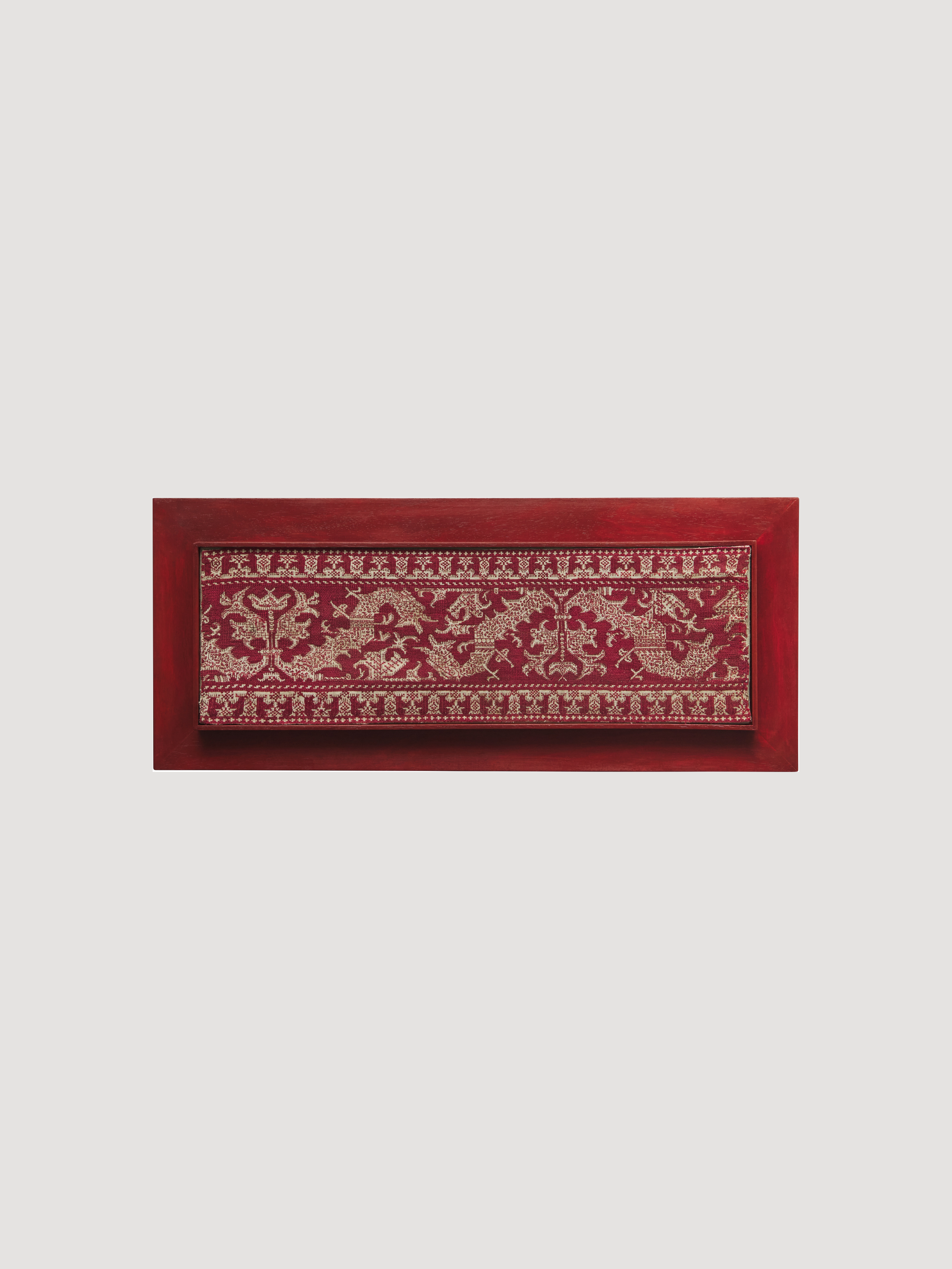
An Azemmour silk-on-linen embroidery depicting snakes and floral motifs
Azemmour, Morocco. Second half 18th century.
Height: 18,5 cm Width: 57 cm (Framed – Height: 29 Width: 57,5 cm)
Additional Information
While the 19th-century Azemmour embroideries frequently depict birds (pigeons or peacocks), earlier 18th-century examples like this one often incorporate more ancient motifs, such as serpents. In the Maghrebi tradition, the snake is a powerful apotropaic symbol—a protective figure intended to ward off the "Evil Eye" and guard the household. The presence of these confronted snakes, flanking the central floral axis, suggests a deep connection to Mediterranean and Judeo-Moroccan folklore, where such zoomorphic figures served as talismans of fertility and protection.
This piece is a technical masterclass in the reserved embroidery style. Unlike other Moroccan traditions where the silk creates the pattern, here the artisan has painstakingly filled the entire background with red silk, leaving the natural linen to define the floral and zoomorphic shapes. This labor-intensive process requires a precise mathematical count of the linen threads to ensure perfect symmetry. The use of high-quality, vegetable-dyed silk has preserved a vibrant, deep carmine tone that remains remarkably consistent despite the textile's significant age.
Provenance
Private collection, London, United Kingdom.
An Azemmour silk-on-linen embroidery depicting snakes and floral motifs
Azemmour, Morocco. Second half 18th century.
Height: 18,5 cm Width: 57 cm (Framed – Height: 29 Width: 57,5 cm)
Additional Information
While the 19th-century Azemmour embroideries frequently depict birds (pigeons or peacocks), earlier 18th-century examples like this one often incorporate more ancient motifs, such as serpents. In the Maghrebi tradition, the snake is a powerful apotropaic symbol—a protective figure intended to ward off the "Evil Eye" and guard the household. The presence of these confronted snakes, flanking the central floral axis, suggests a deep connection to Mediterranean and Judeo-Moroccan folklore, where such zoomorphic figures served as talismans of fertility and protection.
This piece is a technical masterclass in the reserved embroidery style. Unlike other Moroccan traditions where the silk creates the pattern, here the artisan has painstakingly filled the entire background with red silk, leaving the natural linen to define the floral and zoomorphic shapes. This labor-intensive process requires a precise mathematical count of the linen threads to ensure perfect symmetry. The use of high-quality, vegetable-dyed silk has preserved a vibrant, deep carmine tone that remains remarkably consistent despite the textile's significant age.
Provenance
Private collection, London, United Kingdom.