
 Image 1 of 1
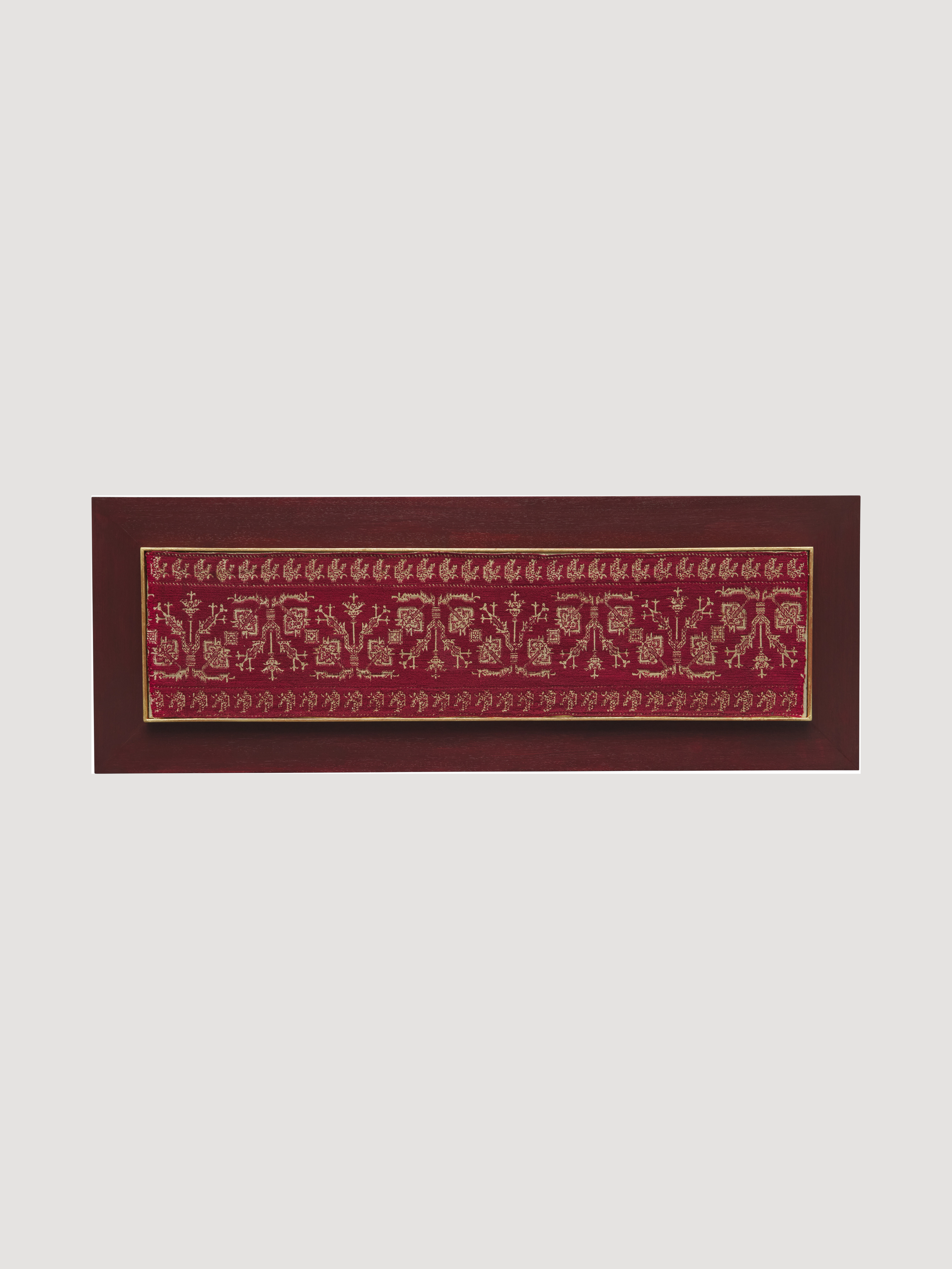
A large Azemmour silk-on-linen embroidery depicting pomegranates and spider plant
Azemmour, Morocco. Late 18th century.
Height: 26 cm Width: 103 cm (Framed – Height: 43,5 cm Width: 120 cm)
Additional Information
This exquisite 18th-century silk embroidery on linen comes from Azemmour, a historic Moroccan town on the Atlantic coast known for its refined textile tradition.
During the 16th to 18th centuries, trade routes and contacts between the Maghreb, the Iberian Peninsula and the Christian Mediterranean led to a remarkable aesthetic fusion. These works show clear influences from Andalusian Mudejar embroidery, with its rhythmic symmetries and taste for ornamental repetition, as well as affinities with the embroidery of Assisi in central Italy, famous for its “punto Assisi” technique, which reverses the negative and positive of the design to create balanced and luminous compositions.
In this example, in which the European influence is most prominent, stylised floral motifs alternate with geometric compositions that evoke both Islamic arabesques and Mediterranean Renaissance sensibilities. The combination of mathematical discipline and manual delicacy makes this work a perfect synthesis between the two shores of the sea: the Maghreb and Europe.
Provenance
Private Collection, London, United Kingdom
A large Azemmour silk-on-linen embroidery depicting pomegranates and spider plant
Azemmour, Morocco. Late 18th century.
Height: 26 cm Width: 103 cm (Framed – Height: 43,5 cm Width: 120 cm)
Additional Information
This exquisite 18th-century silk embroidery on linen comes from Azemmour, a historic Moroccan town on the Atlantic coast known for its refined textile tradition.
During the 16th to 18th centuries, trade routes and contacts between the Maghreb, the Iberian Peninsula and the Christian Mediterranean led to a remarkable aesthetic fusion. These works show clear influences from Andalusian Mudejar embroidery, with its rhythmic symmetries and taste for ornamental repetition, as well as affinities with the embroidery of Assisi in central Italy, famous for its “punto Assisi” technique, which reverses the negative and positive of the design to create balanced and luminous compositions.
In this example, in which the European influence is most prominent, stylised floral motifs alternate with geometric compositions that evoke both Islamic arabesques and Mediterranean Renaissance sensibilities. The combination of mathematical discipline and manual delicacy makes this work a perfect synthesis between the two shores of the sea: the Maghreb and Europe.
Provenance
Private Collection, London, United Kingdom