
 Image 1 of 1
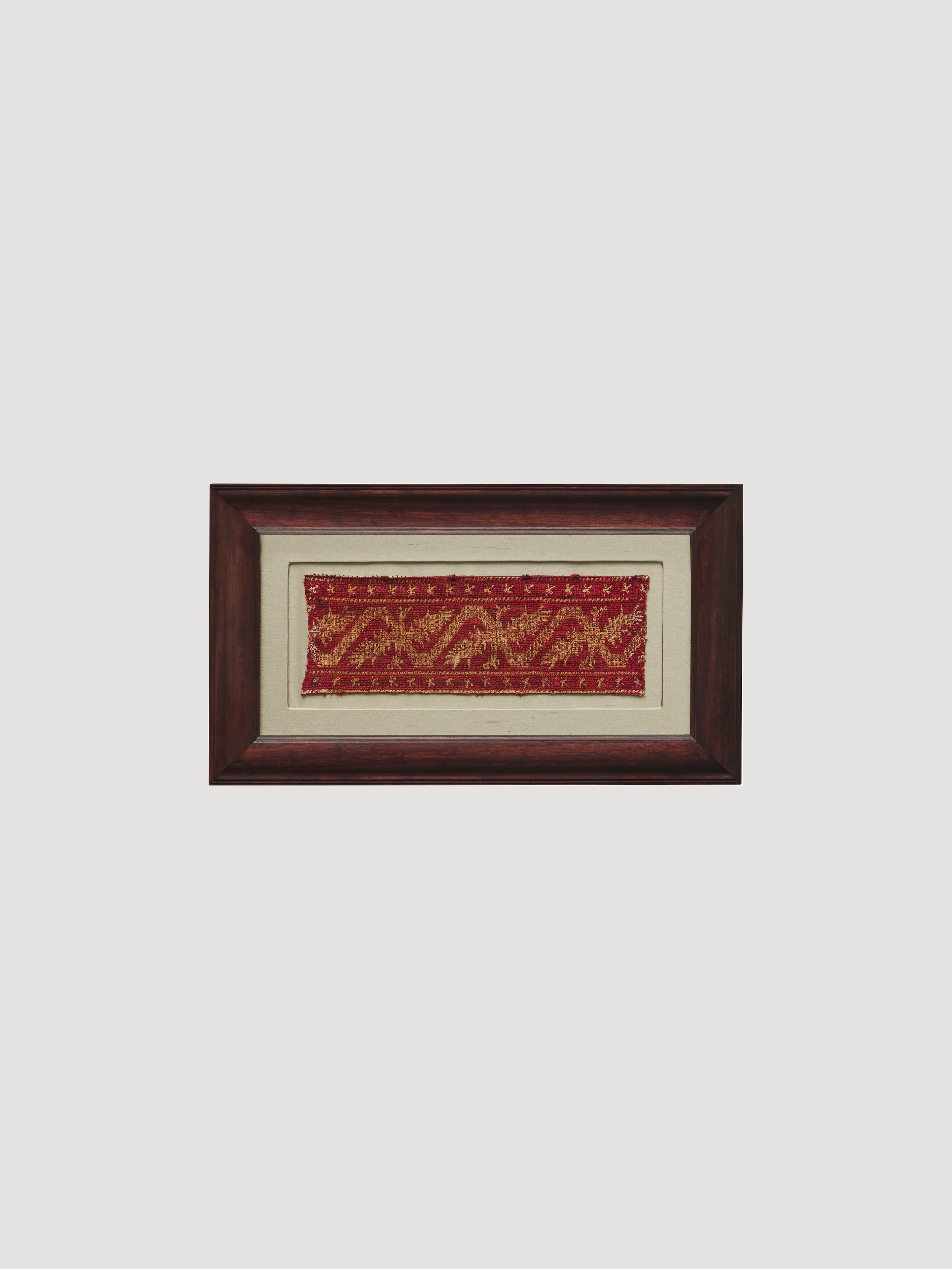
An Azemmour silk-on-linen embroidery depicting dragons
Azemmour, Morocco. Late 17th century.
Height: 12,5 cm Width: 35 cm (Framed – Heigh: 32 cm Width: 56 cm)
Additional Information
The appearance of dragons in this 17th-century Azemmour embroidery marks it as a significant historical survivor. Unlike the later birds and pomegranates of the 18th and 19th centuries, the dragon motif is a direct legacy of the trans-Mediterranean dialogue between Morocco and Southern Europe. Following the expulsion of the Sephardic Jews and Moriscos from the Iberian Peninsula, these artisans brought with them Renaissance patterns—including mythical beasts—which were integrated into the local Maghrebi aesthetic. By the end of the 17th century, these zoomorphic figures were still a vibrant part of the Azemmour repertoire, making this piece a rare witness to a vanished iconography.
In this early period, the voided technique reached its peak of density. The linen ground is not merely a base but is used as a sculptural element to define the dragons' anatomy. The silk itself exhibits the deep, earthy red characteristic of 17th-century natural dyes, likely derived from local madder root or imported cochineal. The intensity of the pigment after more than three centuries is a testament to the high quality of the materials used in the coastal ateliers of Azemmour during the Saadi and early Alaouite eras.
Early Azemmour embroideries of this caliber are seldom found outside of institutional collections. The fragment represents the sophisticated domestic culture of Morocco’s Atlantic coast, where textiles served as the primary medium for artistic expression and social prestige.
Provenance
Private collection, London, United Kingdom.
An Azemmour silk-on-linen embroidery depicting dragons
Azemmour, Morocco. Late 17th century.
Height: 12,5 cm Width: 35 cm (Framed – Heigh: 32 cm Width: 56 cm)
Additional Information
The appearance of dragons in this 17th-century Azemmour embroidery marks it as a significant historical survivor. Unlike the later birds and pomegranates of the 18th and 19th centuries, the dragon motif is a direct legacy of the trans-Mediterranean dialogue between Morocco and Southern Europe. Following the expulsion of the Sephardic Jews and Moriscos from the Iberian Peninsula, these artisans brought with them Renaissance patterns—including mythical beasts—which were integrated into the local Maghrebi aesthetic. By the end of the 17th century, these zoomorphic figures were still a vibrant part of the Azemmour repertoire, making this piece a rare witness to a vanished iconography.
In this early period, the voided technique reached its peak of density. The linen ground is not merely a base but is used as a sculptural element to define the dragons' anatomy. The silk itself exhibits the deep, earthy red characteristic of 17th-century natural dyes, likely derived from local madder root or imported cochineal. The intensity of the pigment after more than three centuries is a testament to the high quality of the materials used in the coastal ateliers of Azemmour during the Saadi and early Alaouite eras.
Early Azemmour embroideries of this caliber are seldom found outside of institutional collections. The fragment represents the sophisticated domestic culture of Morocco’s Atlantic coast, where textiles served as the primary medium for artistic expression and social prestige.
Provenance
Private collection, London, United Kingdom.